
Introducing Gene Food Environment


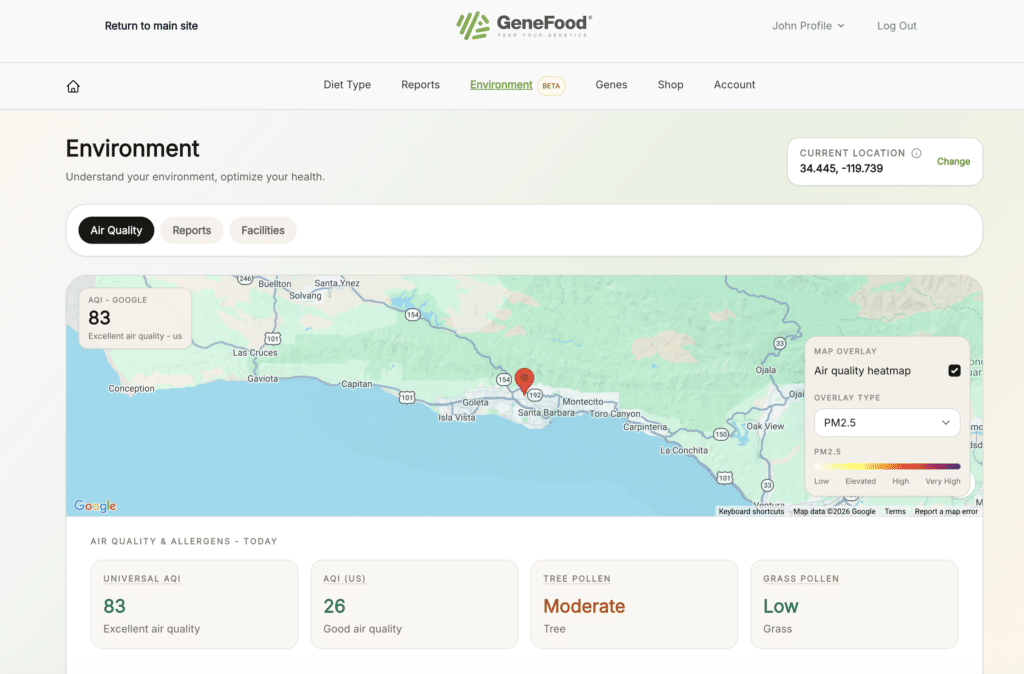
Today, I am pleased to announce the launch of Gene Food Environment, the founding product of personalized environmental genomics. This is a one of one product in the health space. With the launch, our tagline has changed to “Food is just the beginning.”
Why?
Because the air we breathe, the environment we live in, are major drivers of how healthy we are, and counter intuitively, how we react to food. The link between food and environment is well documented and growing.
In 2024, the University of Melbourne tracked 5,276 children for ten years. Babies exposed to higher air pollution had more than double the odds of developing a peanut allergy that persisted into adolescence — confirmed by oral food challenge, the gold standard.
A 2021 prospective study in 139,000 American adults found that long-term PM2.5 exposure raised colorectal cancer risk — and the effect was modified by specific genetic variants. Same pollution, different genomes, different cancer risk, but also different levels of gut inflammation as well. People don’t realize that the air they breathe, and not just the food they eat, plays a big role in the state of their gut health and mental health.
A UK Biobank study tied long-term air pollution to higher rates of depression and anxiety, with the strongest signal in people genetically predisposed. We know that glucoraphinin, a potent antioxidant found in brocolli sprouts stimulates to the NrF2 pathway which allows for greater excretion of VOCs, like benzene.
These data points only scratch the surface of what we know about the significant ways our environment impacts health, and how we can shape protocols based on the air we breathe.
With the launch of Gene Food environment, we now have the tools to personalize our response to different conditions and places.
We have come a long way
Gene Food has always been a passion project for me. Faced with declining health after years of too much work stress and too many late nights in New York City, I started looking in earnest for “the best diet.” Rather than any meaningful consensus, what I found was partisanship that would make our politicians blush.
Vegan heavy films like What the Health, Forks Over Knives, and the Game Changers, even if they were directionally correct, overreached, and the backlash has been severe. Born of plant based maximalism was a predictable turn the opposite side of the spectrum. Carnivore voices got loud and adoption exploded. “Fat adapted” LDL deniers are stronger than ever despite defeats at the hands of their own cherry picked studies.
I see the convergence of chronic illness and algorithms. People want answers, tech wants engagement, and what passes for health content serves neither. The motivations to make someone watch until the end, or click on a thumbnail, are not aligned with helping confused people navigate a world they feel increasingly unhealthy in.
Answers and engagement are often mutually exclusive. And yet, the extreme voices get pushed to the top of the feed. But underneath the social media fueled degradation of health and wellness content, lives a simpler, non-partisan truth.
It’s not the food
Or at least not all the food. I am sorry guys, but pizza isn’t that different in Costa Rica or Italy. What is very different is the air.
The Environment plays a much larger role in these conversations than anyone yet recognizes.
In my own journey, I have seen wild swings in health based on almost solely on my physical location, and these changes directly impacted my nutrition, and how I reacted to food. Moving to Austin, Texas was the most eye opening thing I have ever done. The environment made me ill, a fact I came to realize through trial and error, but that was denied to me by any physician I spoke with. Places like Austin has tectonic allergy and mold burden in the ambient air, and a growing level of air pollution, but despite the packed waiting rooms for allergy shots, no one connects the dots of chronic illness.
Of course, many people who come to places Austin or Dallas will be fine, the point here is not to create dogma. Our goal instead is to introduce the concept of Environmental phenotype to the marketplace of ideas.
Even physicians trained to treat “sensitive patients” foreclosed for me the possibility that Environment was the driver of my illness.
The research is there – we need more
Here is the problem. The protocols prescribed to me, bentonite clay, quercetin, claritin, activated charcoal, botanicals, when compared to GWAS data on environmental sensitivity, look medieval.
Who is really healing from this?
The stories of the total remission of food sensitivity on vacation to Italy, or Hawaii, or Costa Rica are profound, yet they get dimissed as antidote, and we vaguely describe undefined differences in the food supply as the cause. Italy imports wheat from the United States, so does Costa Rica.
When our science team dug deeper, we found markers like IL-18, associated with hypersensitivity to Alternaria, including in the ambient air. The inflammatory trigger is aggravated by the presence of elevated PM 2.5 and air pollution. So much so that researchers who have looked at IL-18 coined the term “IL-18opothies,” because this forgotten cytokine can trigger inflammation across almost all organ systems including the brain, liver, digestive tract, and even the prostate.
We built Gene Food Environment to empower people with information about their genetic predispositions for environmental sensitivity combined with real time air quality metrics. Our user base now has the option to optin to our research cohort to participate in studies to shed light on this important topic.
Despite mountains of GWAS data, no one is looking at this issue. In how many cases is the carnivore dieter who has become reactive to all food reacting to food, and in how many cases is the reaction downstream of something much larger?