
The 7 Best Sites to Upload and Interpret 23andMe Raw Data (2027)

Genes Mentioned

With new genome wide association studies (GWAS) published regularly now, the market for consumer genomics products has been exploding, especially in the nutrition and health space.
With millions of people having ordered genetic testing kits, it’s only natural many of us are looking for ways to get more from the raw data provided by the most popular providers like 23andme, Ancestry, and My Heritage DNA.
At Gene Food, we also supply users with their raw data upon request. Our data files are generated using the Illumina Global Screening Array v2.2 (GSA v2.2) with custom content, which analyzes approximately 731,000 single nucleotide polymorphisms (SNPs) across the genome. We have handled raw data files securely for years now and are experts in the field.
One note before we start: 23andme filed for Chapter 11 in March 2025, and on July 14, 2025 the nonprofit TTAM Research Institute completed a $305M acquisition of its assets, so it now runs as a nonprofit public benefit corporation — it isn’t shut down, and raw-data download still works. If you need your file, our step-by-step guide walks the current path.
Many of our users test with us and then take the raw data to third party tools, just as 23andme users have done now for quite some time.
If you are looking to follow in their footsteps, let’s take a look at the best tools for reading and interpreting raw data.
Which genes are included in raw data?
Both 23andme and Ancestry offer up a limited subset of genes for their customers. As the name denotes, Ancestry.com is more focused on family lineage, whereas 23andme places a greater emphasis on health and wellness.
However, it is important to realize that neither provider offers full genome sequencing. Instead they “genotype.” If you haven’t tested yet, our guide to the best DNA tests covers which kit to pick.
While full genome sequencing looks at all your genes, genotyping analyzes the most studied genes (only a small fraction of the genome). You could think of it this way: on a long road trip cross country, genome sequencing includes every city, no matter how small, in its final map. By contrast, genotyping picks only the major cities. We created the visual below to better demonstrate the difference between sequencing the whole genome vs. genotyping.
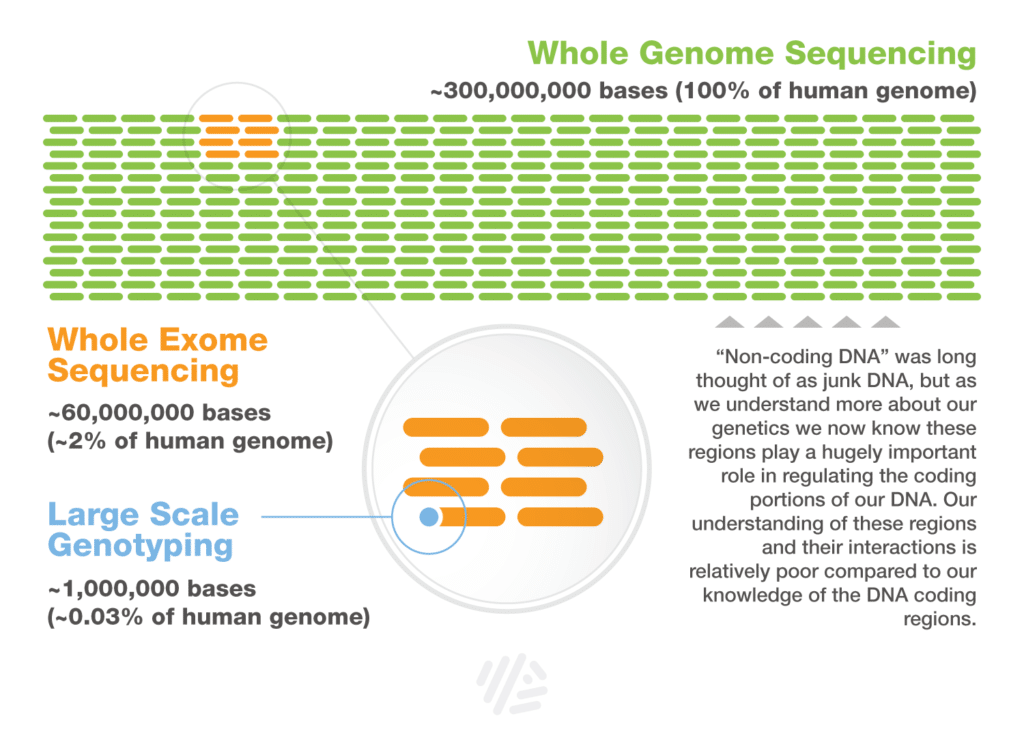
It’s important to realize that the raw data you get from the major providers only offers about 0.02% of your genome. While the interface and content emphasis is different for different providers, Ancestry and 23andme report on a very similar subset of genes. Further, the big boys are constantly changing the game as to which genes are included in which version of their product.
For example, Gene Food is a one of the sites that will process raw data for you from 23andme or Ancestry. Part of what we do with this data is to score our clients for fat metabolism, antioxidant capacity and also more obscure processes like histamine clearance. Based on that score, we place people into one of 20 diet types and offer them access to a custom recipe database. But here’s the kicker: 23andme and Ancestry routinely change the genes they report on from version to version, so people who bought kits earlier have more genetic information on certain markers than do others. The histamine genes are a good example. There are more AOC1 genes in version 4 of 23andme than there are version 5.
Having said that, the reason there are a good number of providers who can offer insights into raw data is because the files are easy to read. They come in simple text files making it straightforward for software programs to parse and score data.
If you’re looking for the top destinations to take your raw data, you’ve come to the right place. Below, I’ve listed the providers I have used and trusted with my raw data.
Already tested with 23andMe, Ancestry, or MyHeritage? Upload your raw data and get your personalized diet type and health reports — in minutes, no new test needed.
Upload your raw data#1. Gene Food
Best for: anyone interested in learning more about nutrition, supplements, core health insights, methylation
You knew we were going to include our own app, right?
For those of you interested in a resolution to the diet wars, we created our custom nutrition plan. Dr. Aaron Gardner, our resident geneticist and head of research, drew up an algorithm that will place you into one of 20 diet types based on your raw genetic data from 23andme or Ancestry.
For example, carriers of a gene known to increase risk for dementia, called APOE4, will usually fall into one of our diet types that is lower in saturated fat from all sources, but especially from animal products. Those that carry more robust fat genes, but who are likely to have problems regulating blood sugar levels, would fall into a more Paleo style of Mediterranean diet that limits carbs, especially refined carbs. Once you have your assigned diet type, our recipe database comes alive with a system of eating that is designed for your DNA and easy to follow.
Later in the report, we dive into more technical issues such as MTHFR and methylation status, tips for building an optimal supplement regimen, as well as sterol absorption and genes that affect detox pathways.
Today the app scores 251 variants across 47 reports — the Diet Type plus 19 core reports and 28 optional add-ons spanning cardiovascular, methylation, longevity and metabolic health — and it uses polygenic risk scores rather than single-variant lookups. Access is lifetime with no subscription, and reports we publish later show up in your account automatically. There’s also Gene Food Environment: seven pathway reports plus live air-quality and pollen data for where you live.
#2. LiveWello
Best for: health care professionals and their clients
LiveWello is in a category of sites that use genetic raw data to offer insight into disease states and possible risks for serious illness. While the site can be a useful place to research whether you carry an obscure genetic marker, or to share a story in one the genetics forums, overall my experience with LiveWello and Promothease was that of drinking from a fire hose. There is so much information that it becomes difficult to separate the good from the highly speculative.
Having said that, if you are simply looking for information about whether you carry certain MTHFR variants, or other more “popular” markers like COMT, LiveWello could be just what the doctor ordered.
Since LiveWello allows for the management of multiple profiles from the same account, and because of the ability to create custom genetics reports and to search by SNP, this site could also be a good option for clinicians and health care providers.
Pricing is a one-time $19.95 per profile, and the multi-profile management, SNP search and custom report templates are what make it work for clinicians.
#3. Self Decode
Best for: a deep dive into genetics and lab test analysis
We have been impressed with the growth of Self Decode over the last few years in particular. Originally founded by Joe Cohen on a website known as Self Hacked, Self Decode offers comprehensive test kits and lab testing analysis, but also offers raw data upload services. Self Decode has built 1,500+ health reports available to customers who upload raw data, including the basics like MTHFR status. Uploading an existing DNA file starts at $319, with kit bundles up to $899, on a membership model. One catch: an uploaded 23andme or Ancestry file doesn’t unlock everything — SelfDecode reserves its Methylation, Detox, pharmacogenomics and 130+ medical reports for data it sequenced itself.
#4. Promethease
Best for: health care professionals and their clients
Data from Promethease is sourced from SNPedia, a large, and very technical database of genes and common polymorphisms. This is one of the genetics sites I used when I was first getting started with genetics research. Ahhh, the good old days of that terrible feeling where reading a genetics report completely out of context convinced me I was sure to develop X, or Y disease. Unless you have a science or genetics background, Promethease is a less user friendly LiveWello.
One nice feature of the service is that you can view some sample reports without uploading your raw data. For example, here is a sample report they link to on their homepage that uses 23andme data. Most reports on Promethease cost $25, plus $4 per additional file merged in.
Again, for a geneticist or someone with deep scientific knowledge, this site may prove very useful. For the average consumer, I think it’s a stress multiplier and another fire hose.
#5. Genetic Genie
Best for: those just getting started on their genetics journey, those who just want to know MTHFR status
I’ve always liked Genetic Genie. It’s a free report (although you have the option to donate) that gives a concise methylation report with a solid panel of SNPs to choose from. Users also have the option of choosing their detox panel, also free. Genetic Genie is a straightforward way of using raw genetic data to get some of the top line information 23andme and Ancestry choose not to report on.
Both the Methylation and Detox panels are still free (donations welcome), and it now accepts Ancestry as well as 23andme — the site actually flags Ancestry as carrying the most clinically relevant data.
#6. Genomelink
Best for: Entertainment and fun genetics reports
I wrote a review of Genomelink, a Y Combinator–backed genomics company. It’s upload-only: you export your raw data file and upload it, since 23andme shut off its third-party API back in 2018, so there’s no account-connect shortcut. Genomelink offers a suite of tests for personality traits, some ancestry reports, basic micronutrients, and other bits that skew toward entertainment value. The free tier gives 100 trait reports; a paid tier unlocks 350+.
Some Reddit posters have called Genomelink a scam over poor customer service. I’m less harsh — the investor backing is real — but the product itself could still use some work in my opinion.
#7. StrataGene
Best for: health care professionals and their clients
StrataGene is the brain child of Dr. Ben Lynch of MTHFR and Dirty Genes fame. Dr. Lynch was one of the pioneers of nutrigenomics and is widely recognized as an authority on using genetics as a tool for better integrative medicine. He is also the founder of a supplement company called Seeking Health. Seeking Health is thought of as a high quality brand that sources good ingredients. To his credit, at least when I used StrataGene a few years back, the reports were not making supplement recommendations.
StrataGene is another report that uses raw genetic data to provide technical reports. Most consumers will not be able to get much from these reports unless they are working with a healthcare provider.
Highlights for StrataGene are the folate cycle (methylation), methionine cycle, and transsulfuration and histamine pathways. All of the pathways are highlighted with a chart which shows the user the biochemical reactions at play driving different outcomes and where their pathway may be disrupted.
This is a report that can be taken to a doctor versed in nutrigenomics, but it will be too complicated for most consumers. It’s a one-time $95 report, and it now accepts all 23andme versions — though for Ancestry it still takes V2 only (kits bought after May 2016).
Already tested with 23andMe, Ancestry, or MyHeritage? Upload your raw data and get your personalized diet type and health reports — in minutes, no new test needed.
Upload your raw dataHow to choose safely
Before you upload, know what a site does with your file. Ask three things: does it store your raw data, can you delete it, and how does it make money? “Free” reports often aren’t — the cost can be data monetization or upsells. Prefer services with a clear deletion path and no data-sale policy, and if you plan to run results through a chatbot, read this first. For the full picture on removing your data, see our guide to deleting genetic data.
Closing Thoughts
The genetics world is changing rapidly. Steve Jobs was reported to have paid $100,000 to have his genome sequenced. Today a 30x whole-genome sequence runs roughly $300–$500 (Nucleus is about $399).
Whole-genome sequencing is now genuinely affordable — but genotyping still wins on cost and simplicity for most people, which is why these upload sites still matter.
For now, the genotyping services like 23andme and Ancestry provide value, both from a health and entertainment standpoint. Extracting your raw data will give you access to a far greater range of genes than the large providers discuss in their interfaces. However, careful the conclusions you draw from the data. In some cases, the knowledge can be powerful. In others, trying to piece together mechanisms even some of the best scientists have yet to understand can leave people stressed out and confused.
23andme raw data upload FAQ
Can I still upload 23andme data in 2026? Yes. Despite the 2025 bankruptcy and nonprofit TTAM takeover, download and upload both still work. Export your raw data file from 23andme and upload it to any site on this list.
Which sites accept Ancestry files? All seven accept AncestryDNA, though StrateGene takes V2 only (kits after May 2016). Promethease, SelfDecode, Genetic Genie and Genomelink also accept 23andme, MyHeritage and other formats.
Are these reports medically actionable? Generally no. They flag variants but aren’t diagnostic, and markers outside a provider’s vetted reports aren’t individually validated. Use them to inform a conversation with a clinician, not to self-diagnose.
What’s the difference between a polygenic score and a single-variant report? A single-variant report gives your genotype at one SNP. A polygenic score combines many variants into one weighted estimate — usually more predictive. Gene Food scores polygenically; several sites here are single-variant.
Is it safe to upload my raw data? It depends on the site. Check whether it stores your file, lets you delete it, and whether it sells data. “Free” tools often monetize or upsell, so prefer clear deletion and no-sale policies.